Chatham House: pro-Russian sentiments in Belarus are at their highest in 5 years

На мітынгу ў 2020
The number of supporters of an alliance with Russia in Belarus by November 2025 reached 44% — this is the maximum since September 2020 and plus 6 percentage points compared to December 2024, according to data from Chatham House sociologists.
At the same time the number of supporters of an alliance with the EU and Russia simultaneously decreased (22% in November of this year compared to 29% last December). The number of those who consider an alliance with the EU the best option has remained more or less at the same level since 2022 — in November there were 15% of such people.
At the same time the Russian war in Ukraine is supported by only 27% (in December 2024 there were 32% of such). 38% condemn it, and the remaining 34% found it difficult to answer.
What else interesting did sociologists learn from the survey?
More and more “find it difficult to answer”
On a number of questions about the war since August of this year the number of Belarusians who chose “find it difficult to answer” has noticeably increased.
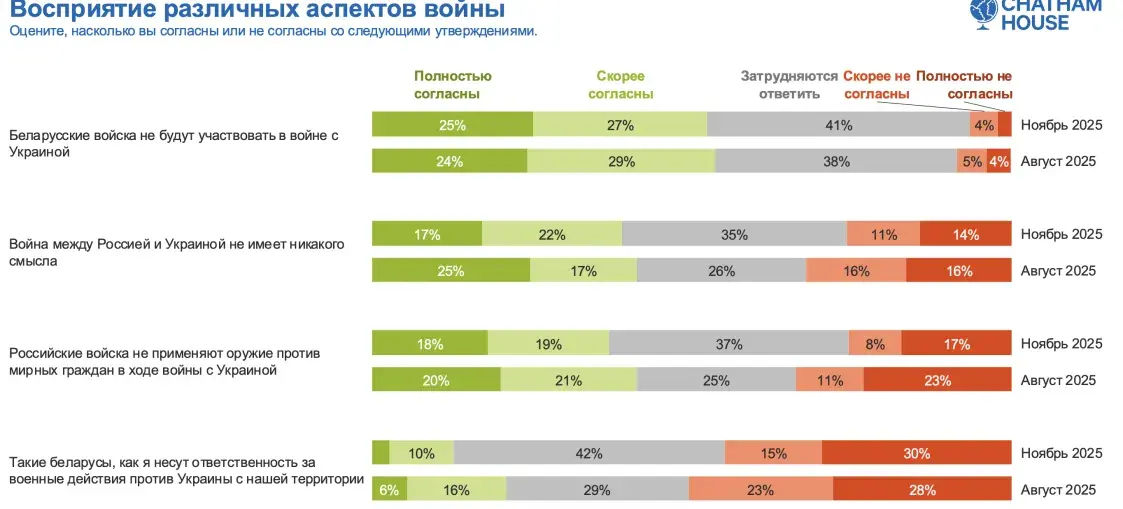
For example, in response to the request to agree or not with the statement “Belarusian troops will not participate in the war with Ukraine” 41% of Belarusians answered this way (it was 28%).
To give an assessment of the thesis “The war between Russia and Ukraine has no meaning” was difficult for 35% (it was 26%), and to the statement “Belarusians like me bear responsibility for military actions against Ukraine from our territory” — 42% versus 29% in the previous survey.
It is interesting that more “find it difficult to answer” also appeared in answers to most questions about awareness of important events of recent times. For example, this option next to the topic of negotiations between Russia and Ukraine was chosen by 18% (it was 11%). And on the topic of potato shortage “found it difficult to answer” 12% (it was 7%).
What Belarusians think about the release of Sergei Tikhanovsky
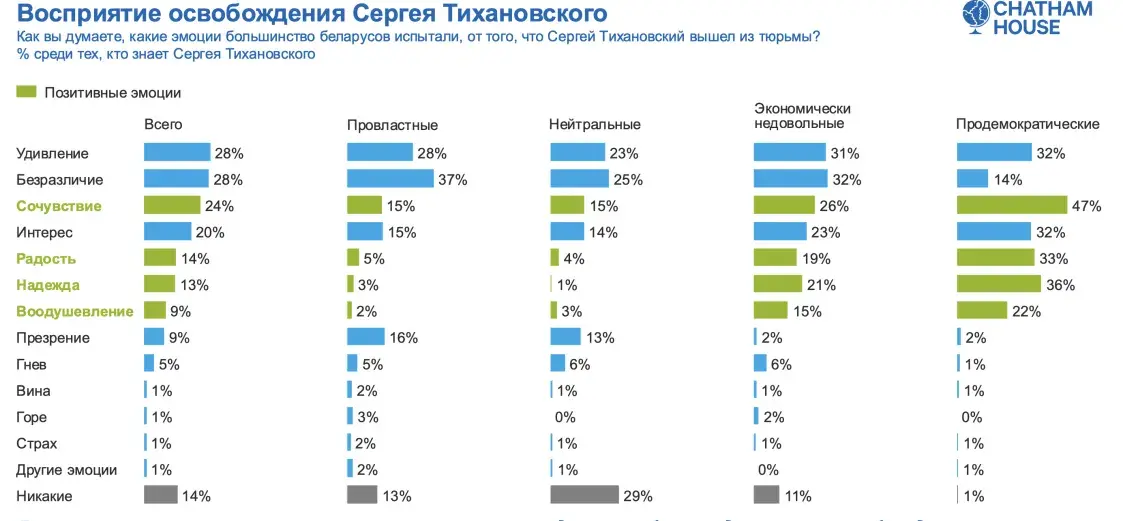
Sociologists asked survey participants to indicate emotions that they felt after the release of Sergei Tikhanovsky, here percentages are given among those who know who he is.
“In all segments a significant part of respondents were surprised by the release of Sergei Tikhanovsky. At the same time pro-democratic participants more often experienced positive emotions, while pro-government ones — mostly indifference,” note Chatham House.
Besides the pro-government group, “indifference” among the leaders also in the neutral audience and in economically dissatisfied Belarusians.
Know about the early release of political prisoners 73% of Belarusians, but 16% are sure that this did not happen. The largest contribution to the point “this did not happen” was made by the so-called “neutrals” — 29%.
In general across the country 32% of Belarusians definitely approve of the releases, and 15% — do not. Even in the pro-government group approval is expressed by 20%, while disapproval — 19%.
Among the neutral group disapproval is expressed by the same 19%, but approval is much less than among the pro-government group — only 11%.
Nuclear weapons in Belarus
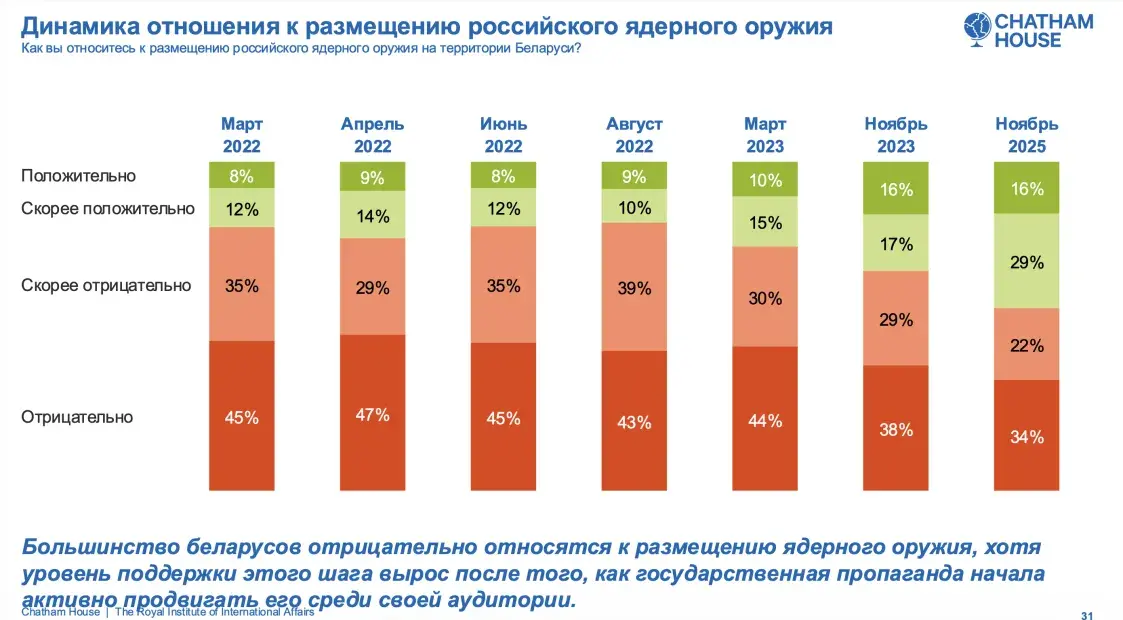
According to surveys, the number of Belarusians supporting the deployment of Russian nuclear weapons in the country is growing: 45% in November, whereas in August it was 33%. Do not approve of this 56% of Belarusians, whereas in August there were 67%.
24% of respondents believe that Russian leadership will manage nuclear weapons in Belarus independently, and another 23% — that Russians “with participation of the Belarusian side”. It is interesting that this option was more often chosen by pro-democratic Belarusians (27%) than pro-government ones (23%). On the other hand, as many as 26% of pro-government Belarusians believe that Belarus and Russia will decide on equal terms.
Belarusians were also asked what they know about the support by Belarusian authorities of Russian aggression against Ukraine. In the lead — treatment of Russian soldiers (40%) and repair of Russian military equipment (33%), while the points about providing territory for invasion and missile strikes were chosen by less than a quarter of the population (21% and 17% respectively).
“Most often Belarusians believe that Belarus treats Russian military, repairs equipment and provides airfields. Some pro-government people also believe that Belarus restrains NATO forces in other directions,” say sociologists.
Situation in the country
It is interesting that the most satisfied with the economic situation in Belarus are not only pro-government Belarusians but also neutrals (80% and 61% respectively). In both groups the majority also agree with the thesis that Belarus needs a strong hand of a leader (91% and 52%), as well as that over the last year the situation in the country is going in the right direction (82% and 61%).
But the economically dissatisfied group is more inclined in views toward the pro-democratic.
How the survey was conducted
“Chatham House surveyed 713 respondents in August and November 2025. Our sample corresponds to the structure of the urban population of Belarus and was adjusted by gender, age, size of settlements and level of education,” explain sociologists.
The survey was conducted on a special online panel, therefore the sample is limited to Internet users (94% of the population).
“Therefore, despite the fact that the sample was weighted to accurately reflect the structure of Belarusian society, there is a probability that support for Lukashenka’s policy may be slightly higher than reflected in the survey, since supporters of Lukashenka are often less socially and economically active than his opponents. On the contrary, the influence of the fear factor during the survey may underestimate the share of critical answers regarding the current authorities.”
Translation carried out with the help of AI.